Our “Reading Comprehension and Language Development” series is going on! But this time, our stories have a more ambitious purpose: they are designed not only to entertain you, but also to strengthen your vocabulary, reading comprehension, critical thinking, and language skills that can help you achieve a higher IELTS or TOEFL score.
When the first machine recognised that someone was about to cry, nobody in the laboratory applauded.
They simply stared at the screen.
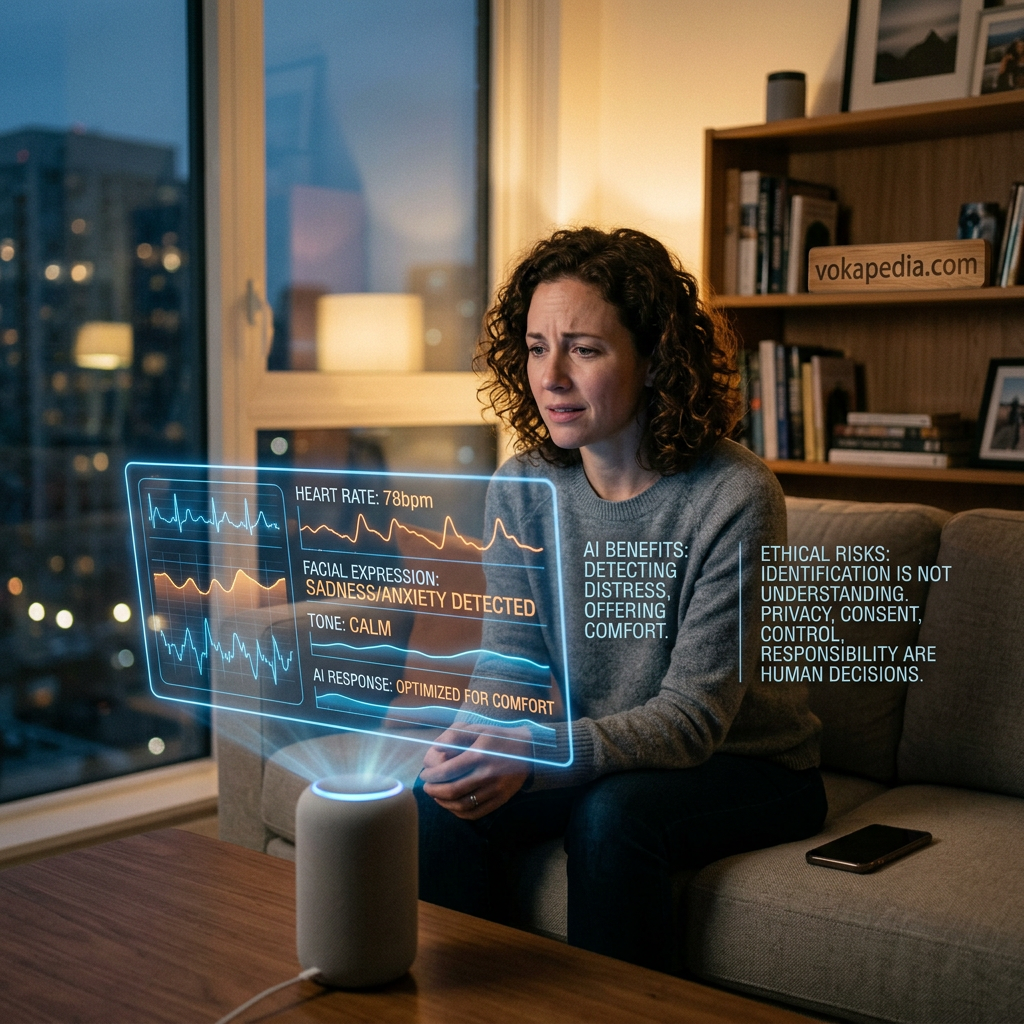
The machine, called EVA, had been designed to analyse facial expressions, tone of voice, and patterns in speech. Its creators hoped that it could eventually help doctors, teachers, and caregivers understand people who found it difficult to express their emotions.
That morning, however, EVA had done something unexpected.
A researcher named Brian was discussing an ordinary experiment when the system interrupted him.
“Brian appears distressed,” it reported.
Brian laughed.
“I’m not distressed. I’m tired.”
The machine paused.
“Your words indicate that you are fine. Your voice and facial expressions suggest otherwise.”
Nobody spoke.
Brian had recently lost his father, but he had deliberately avoided discussing it at work. He had assumed that, as long as he behaved normally, nobody would notice.
Apparently, the machine had noticed.
Within months, EVA became remarkably accurate at identifying emotional patterns. It could detect hesitation in a student’s voice, recognise signs of anxiety in a patient, and identify subtle changes in someone’s behaviour.
The possibilities seemed extraordinary.
A teacher could be alerted when a student was struggling before that student asked for help. A doctor might notice emotional distress that a patient had concealed. An elderly person living alone could receive support when their speech suggested unusual sadness or confusion.
But then Brian asked a question that changed the direction of the project.
“Just because a machine can detect something, does that mean it should?”
The laboratory became divided.
Some researchers argued that emotional recognition could save lives. Others warned that the technology could easily be misused. An employer, for example, might monitor workers’ emotions and penalise them for appearing anxious. A company might analyse customers’ reactions in order to manipulate their decisions.
And what if the machine was wrong?
Human beings sometimes smile when they are nervous. They may remain silent when they are angry or laugh when they are uncomfortable. Emotions are complicated, and cultural differences can make them even harder to interpret.
Brian therefore proposed a new rule:
EVA could offer an interpretation, but it could never make the final decision about a person.
The researchers agreed.
They also decided that people should know when the system was analysing them and should have the right to refuse.
Years later, EVA was being used in several hospitals and educational institutions. It had helped identify people who needed support, but it had also taught its creators an important lesson.
Technology did not become more human simply because it could recognise human emotions.
It became more responsible when humans decided how that ability should be used.
Brian sometimes returned to the laboratory and watched EVA analyse a conversation.
He no longer wondered whether machines would eventually understand people better than people understood one another.
Instead, he asked a more important question:
Would people use technology to understand one another—or to control one another?
For Brian, the answer was still being written.
And that, he believed, was good news.
Because the future of intelligent technology would not be determined by machines alone.
It would be determined by the choices people made.
Mini Glossary (English-Turkish)
emotion — a strong feeling such as happiness, sadness, fear, or anger.
Turkish: duygu
distressed — experiencing strong worry, sadness, or emotional pain.
Turkish: sıkıntılı, üzgün, duygusal olarak zor durumda
facial expression — the way a person’s face shows a particular emotion or reaction.
Turkish: yüz ifadesi
hesitation — a pause or delay caused by uncertainty or doubt.
Turkish: tereddüt, kararsızlık
subtle — not obvious or easy to notice.
Turkish: ince, belli belirsiz
manipulate — to influence someone, often unfairly, in order to achieve a particular result.
Turkish: yönlendirmek, manipüle etmek
interpret — to understand the meaning or significance of something.
Turkish: yorumlamak, anlamlandırmak
conceal — to hide something deliberately.
Turkish: gizlemek
ethical — relating to principles about what is morally right or wrong.
Turkish: etik, ahlaki
responsible — behaving in a careful and morally appropriate way.
Turkish: sorumlu, bilinçli
Questions 1–4: Multiple Choice
Choose the correct letter, A, B, C, or D.
1. Why was Daniel surprised when EVA identified him as distressed?
A) He had deliberately tried to hide his emotional state.
B) He had been testing whether EVA could recognise sadness.
C) He had told his colleagues about his father’s death.
D) He believed the machine was incapable of recognising emotions.
2. What does the story suggest about one potential benefit of EVA in education?
A) It could replace teachers in difficult classrooms.
B) It could identify students who might need support before they asked for it.
C) It could determine which students would achieve the highest grades.
D) It could prevent students from experiencing anxiety.
3. What was the main concern raised by some researchers?
A) The technology was too expensive to operate.
B) Machines could never recognise emotions accurately.
C) Emotional information could be used to monitor or manipulate people.
D) Hospitals and schools would refuse to use the technology.
4. What conclusion does Daniel eventually reach?
A) Machines will soon understand people better than humans do.
B) Emotional recognition should be prohibited completely.
C) Technology should be developed without human interference.
D) Human decisions will determine whether the technology is beneficial or harmful.
Questions 5–8: True, False, or Not Given
Do the following statements agree with the information in the story?
Write:
TRUE if the statement agrees with the information
FALSE if the statement contradicts the information
NOT GIVEN if there is no information about this
5. EVA was initially developed primarily for use in hospitals.
6. Daniel’s colleagues were unaware that he had recently lost his father.
7. Some employers could potentially use emotional-recognition technology to evaluate their employees.
8. EVA was eventually rejected by all the institutions that tested it.
Questions 9–12: Matching Information
Which paragraph contains the following information?
Write the correct letter, A–F.
9. an example of a person whose emotions were detected despite their words suggesting otherwise
10. a possible application of the technology that could benefit vulnerable people
11. a warning about the consequences of using emotional information for commercial or professional purposes
12. a principle introduced to prevent the technology from making important decisions independently
Paragraphs
A. Daniel is discussing an ordinary experiment when EVA identifies signs of distress that he himself denies.
B. EVA is presented as potentially useful for teachers, doctors, and people who may need emotional or medical support.
C. Researchers become concerned that employers or companies might use emotional information to influence or control individuals.
D. The researchers establish a rule that EVA may provide an interpretation but must not make the final decision about a person.
E. The researchers discover that cultural differences can make emotional interpretation particularly complicated.
F. Daniel later reflects on the broader relationship between technology and human decision-making.
Answer Key
Multiple Choice:
- A — 2. B — 3. C — 4. D
True / False / Not Given:
5. NOT GIVEN — 6. T — 7. T — 8. F
Matching Information:
9. A — 10. B — 11. C — 12. D
IELTS Skill Focus
Note. This set aims to test several skills that become increasingly important at Band 8–9:
- Locating explicit information
- Understanding implied meaning
- Distinguishing FALSE from NOT GIVEN
- Identifying the writer’s central ideas
- Matching information across paragraphs
- Understanding vocabulary from context
- Following cause-and-effect relationships
The particularly important distinction for advanced learners is FALSE vs. NOT GIVEN: a statement is False when the passage contradicts it, whereas it is Not Given when the passage simply provides no evidence to establish whether it is true or false.
A Short Explanation
Article Title: When Machines Learned to Recognise Emotion (EVA: Navigating the Ethics of Emotional AI)
Article Level: IELTS Band 8+ / TOEFL iBT 6
Suitable for Whom: Advanced English learners preparing for IELTS Academic, TOEFL, or high-level academic and professional English.
Main idea: The article explores both the potential benefits and ethical risks of emotionally intelligent technology. Although machines may become increasingly capable of identifying human emotions, the story argues that recognising an emotion is not the same as understanding a person. Ultimately, the way such technology affects society depends on the decisions humans make about privacy, consent, responsibility, and control.
Short Summary
Brian and his research team develop EVA, a machine capable of recognising emotional signals in people’s voices and facial expressions. Although the technology could help doctors, teachers, and vulnerable people, the researchers realise that it could also be used to monitor or manipulate individuals. They therefore establish limits on how EVA can be used and ensure that people remain in control of important decisions. Brian eventually understands that the central question is not whether machines can understand emotions, but whether humans will use that ability to help or to control one another.
A Question for You
Think about your own life: If an AI system could accurately recognise when you were stressed, worried, or unhappy—even when you said you were fine—would you want it to tell you, a teacher, a doctor, or someone close to you? Why or why not?
Note. VoKaPedia also has a dedicated podcast section where you can find a variety of engaging episodes. I’d definitely recommend exploring it—you might discover something new and inspiring to listen to. Go to VoKaPedia Podcasts.