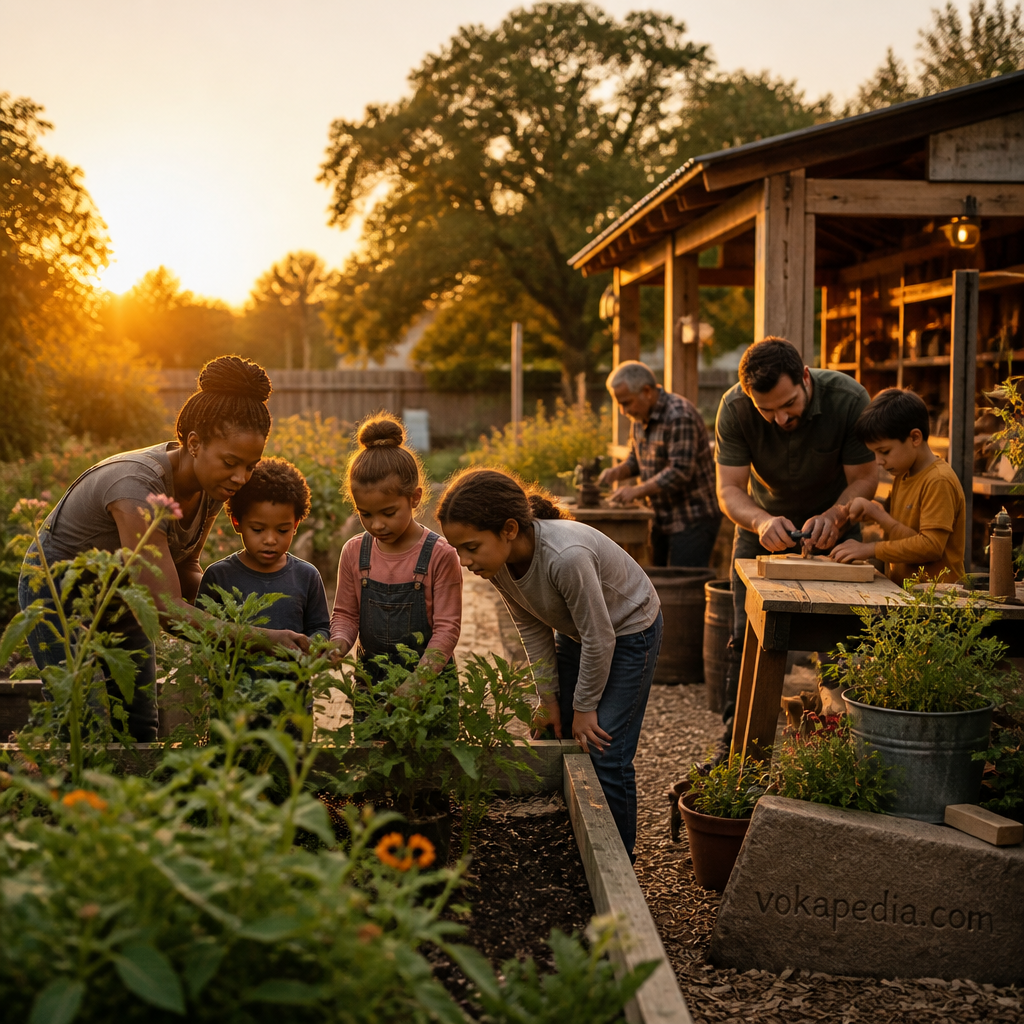
Welcome back to our “Reading Comprehension and Language Development” series! This time, we are stepping into a rather unusual school—one without classrooms, bells, or teachers, where the first lessons begin at home and the first teachers are the parents. Along the way, we will explore a provocative question: before children are prepared to succeed in the world, should they first be prepared to live responsibly in it?
In a small but progressive community called New Harmony, there was no conventional school building. Instead, children were educated primarily at home, and their parents took on the role of their first teachers. The idea was simple but ambitious: education should not merely prepare children to pass examinations; it should prepare them to live responsibly, respectfully, and independently with other people.
The curriculum went far beyond mathematics, science, languages, and history. Children learned to cook, manage money, solve everyday problems, listen carefully, apologise sincerely, keep promises, resolve disagreements, and contribute to household responsibilities. Education was not regarded merely as the accumulation of information; it was seen as preparation for life.
Every family followed a Learning Charter, which established both academic and behavioural expectations. Children were expected to complete their assignments, participate in household tasks, listen when others were speaking, and learn how to disagree without becoming disrespectful. The aim was not to create obedient children, but responsible human beings capable of making thoughtful choices.
Yet the academy had one rule that mattered more than all the others: parents themselves had to be educated before they could educate their children. They were expected to learn about child development, communication, emotional regulation, conflict resolution, and the responsibilities of role modelling. After all, children do not simply listen to what adults teach them; they observe how adults behave. A parent who demands respect but speaks disrespectfully, or who teaches patience but reacts impulsively, may unintentionally teach the very opposite of what they intend. The Parents’ Academy therefore believed that educating a child must begin with educating the educator.
This principle reflected an important reality: the quality of a child’s education depends not only on the curriculum but also on the environment in which learning takes place. Research on children’s development has repeatedly highlighted the importance of supportive home learning environments, including shared reading, meaningful conversations, parental engagement, and opportunities for children to participate actively in everyday life. At the same time, home education itself does not automatically guarantee better outcomes. What matters is the quality of the educational experience and the competence, commitment, and awareness of those providing it.
The philosophy also echoed the provocative ideas of Austrian thinker Ivan Illich, whose 1971 book Deschooling Society challenged the assumption that meaningful learning must always take place inside conventional educational institutions. Illich argued that people learn extensively through everyday experiences, relationships, communities, and participation in real life. The Parents’ Academy took this idea one step further: if learning happens everywhere, then parents must also recognise that they are constantly teaching—even when they are not consciously giving a lesson.
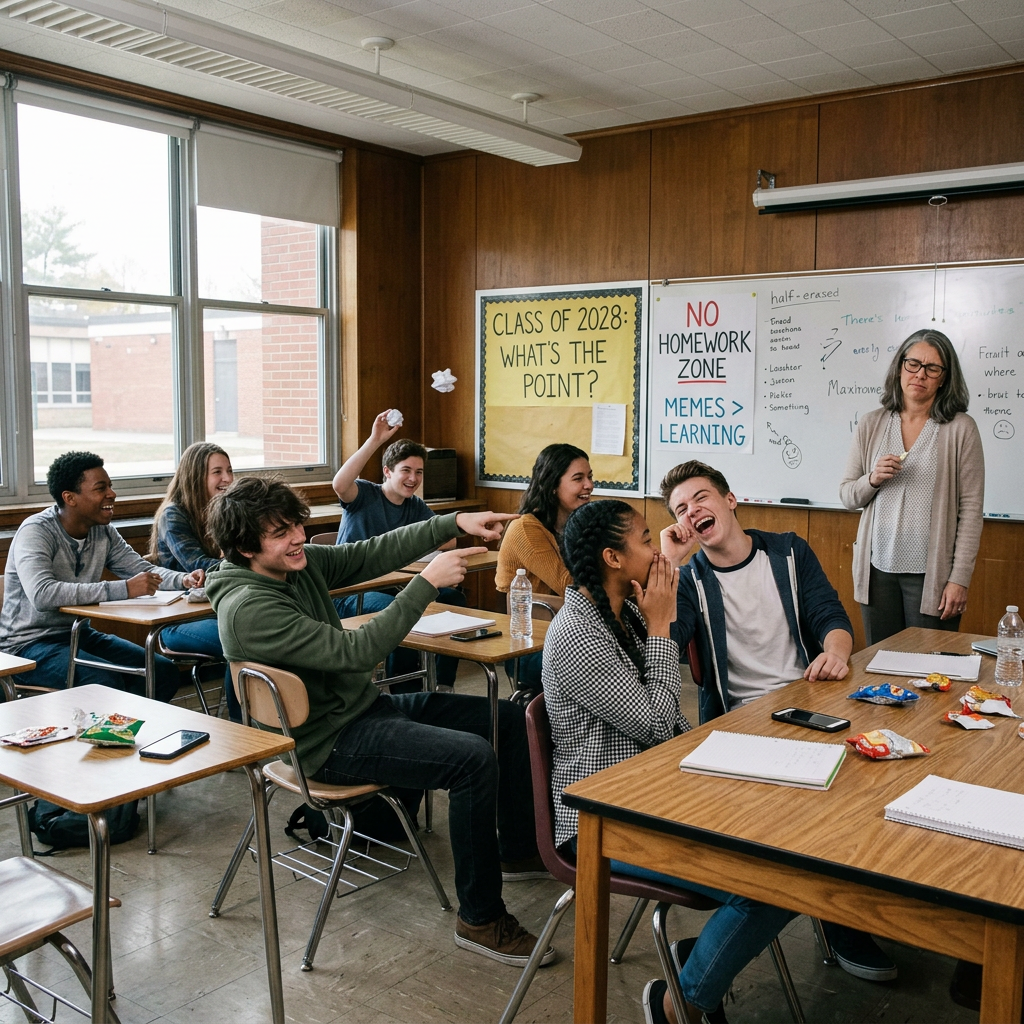
The idea became particularly relevant when some teachers began expressing concern about the behaviour of certain young people. They observed students interrupting others, speaking without listening, treating service workers dismissively, struggling to accept criticism, or assuming that having an opinion automatically entitled them to be heard. Such behaviour, of course, cannot fairly be attributed to an entire generation; discourtesy and poor social skills have existed throughout history. Nevertheless, the observations raised an uncomfortable question: Are we sometimes teaching children how to succeed academically without teaching them how to live respectfully with other people?
At the Parents’ Academy, the final assessment therefore had little resemblance to a traditional examination. Before receiving their diploma, students had to participate in a community event, work with people of different ages, manage a limited budget, resolve a disagreement, respond constructively to criticism, and complete a task without constant parental assistance.
Abraham, one of the oldest students, initially believed he was completely prepared. During the assessment, however, he made several mistakes. He interrupted someone, misunderstood a criticism, and became frustrated when his plan failed. Instead of defending himself, he eventually stopped, listened, apologised, and changed his approach. That moment mattered more than any perfect answer on a written test.
When Abraham completed the final assessment, his parents handed him his Parents’ Diploma. It did not certify that he knew everything. Rather, it recognised that he had developed the ability to continue learning, take responsibility for his actions, respect other people, and contribute positively to a community.
And perhaps that was the academy’s most important lesson. Education is not simply about preparing young people to make a living; it is about preparing them to live. Before we teach a child how to navigate the world, perhaps we should first ask whether we, as parents, have learned how to navigate it ourselves.
After all, before we teach a child how to live in the world, perhaps we should first ask whether we, as parents, have learned how to live in it ourselves.
TRUE / FALSE
Decide whether the statements are True (T) or False (F).
- The Parents’ Academy operated in a conventional school building.
- The curriculum included practical and social skills as well as academic subjects.
- Children were expected to obey their parents without questioning them.
- Parents were required to develop their own educational and interpersonal skills.
- The article claims that home education automatically produces better educational outcomes.
- Ivan Illich questioned the assumption that learning must take place in conventional schools.
- The article states that all members of Gen Z are disrespectful.
- Abraham had to demonstrate practical and social abilities in his final assessment.
- Abraham received his diploma because he completed every task perfectly.
- The academy regarded education as preparation for life as well as academic achievement.
VOCABULARY – Choose the closest meaning
- ambitious
A) aiming to achieve something significant
B) unwilling to change
C) extremely cautious
D) financially expensive - accumulation
A) gradual collection or increase
B) sudden disappearance
C) careful reduction
D) complete rejection - contribute
A) withdraw from something
B) give or add something useful
C) criticize publicly
D) avoid responsibility - disrespectful
A) lacking proper respect
B) highly educated
C) emotionally sensitive
D) socially active - competence
A) confusion
B) ability to do something effectively
C) reluctance to participate
D) desire for independence - provocative
A) designed to stimulate thought or reaction
B) completely predictable
C) deliberately confusing
D) impossible to understand - dismissively
A) in a way that shows little respect or consideration
B) with great enthusiasm
C) with extreme caution
D) in a highly emotional manner - constructively
A) in a useful and positive way
B) without preparation
C) in complete silence
D) in an aggressive manner - navigate
A) find one’s way through a difficult situation
B) avoid learning anything
C) reject outside assistance
D) memorise information - certify
A) officially confirm or recognise
B) secretly investigate
C) publicly criticise
D) temporarily postpone
MINI GLOSSARY (ENGLISH-TURKISH)
| Word / Phrase | English Definition | Turkish Equivalent |
|---|---|---|
| ambitious | having a strong desire to achieve something important | iddialı, kapsamlı |
| curriculum | the subjects and skills taught in an educational programme | müfredat |
| responsible | having a duty to deal with something properly | sorumlu |
| role model | someone whose behaviour can be copied as an example | rol model, örnek kişi |
| emotional regulation | the ability to manage and control emotional responses | duyguları düzenleme |
| competence | the ability and knowledge needed to do something well | yeterlilik |
| discourtesy | behaviour that shows a lack of politeness or respect | nezaketsizlik |
| constructively | in a way that helps improve a situation | yapıcı bir şekilde |
| navigate | successfully deal with a difficult situation | yolunu bulmak, başa çıkmak |
| contribute | to give something that helps achieve a result | katkıda bulunmak |
READING COMPREHENSION
A. Multiple Choice
1. What is the central purpose of the Parents’ Academy?
A) To replace all conventional schools
B) To prepare children for responsible participation in society
C) To ensure that children achieve higher examination scores
D) To reduce the responsibilities of teachers
2. Why does the article emphasise the education of parents?
A) Parents need to obtain professional teaching certificates.
B) Children should spend less time with their parents.
C) Parents influence children through both instruction and behaviour.
D) Parents are more knowledgeable than professional teachers.
3. What does the reference to Ivan Illich mainly illustrate?
A) Learning can take place beyond conventional educational institutions.
B) Parents should completely replace professional teachers.
C) Traditional schools are incapable of teaching academic subjects.
D) Children should never receive formal education.
4. Why is Abraham’s reaction to criticism important?
A) It proves that he had memorised the curriculum.
B) It demonstrates his ability to learn from experience.
C) It shows that he was naturally better than the other students.
D) It allowed him to avoid completing the final assessment.
B. Sentence Completion
Complete the sentences using NO MORE THAN THREE WORDS from the article.
- The Parents’ Academy viewed education as __________ for life.
- Families followed a document called the __________.
- Abraham had to participate in a __________ as part of his final assessment.
- The academy believed that education should prepare young people to __________.
C. Matching Information
Match each statement with the correct paragraph.
A — Paragraph 2
B — Paragraph 5
C — Paragraph 6
D — Paragraph 8
E — Paragraph 10
- A description of the broader meaning of the diploma
- An explanation of why parents need educational preparation
ANSWER KEY
True / False: 1 F, 2 T, 3 F, 4 T, 5 F, 6 T, 7 F, 8 T, 9 F, 10 T
Vocabulary: 1 A, 2 A, 3 B, 4 A, 5 B, 6 A, 7 A, 8 A, 9 A, 10 A
IELTS: 1 B, 2 C, 3 A, 4 B, 5 preparation, 6 Learning Charter, 7 community event, 8 live, 9 E, 10 B
ABOUT THE STORY
Story Title: The Parents’ Academy
Story Level: IELTS Band 8+ / TOEFL iBT 6
Suitable for Whom: Advanced English learners, IELTS/TOEFL candidates, teachers, parents, and students interested in education and society.
Main Idea: True education should prepare young people not merely to achieve academically, but to communicate respectfully, take responsibility, think independently, and live constructively with others—and that process begins with educating the educators themselves.
Summary
The Parents’ Academy imagines a community in which parents become their children’s first teachers and education extends far beyond academic knowledge. The children learn practical, emotional, and social skills at home, while parents are also expected to educate themselves and become responsible role models. Inspired partly by Ivan Illich’s ideas about learning beyond conventional institutions, the story questions whether modern education gives enough attention to character, responsibility, respect, and social competence. Ultimately, it suggests that the first step in educating children may be educating the adults who educate them.
A Question for You
If you could design your own “Parents’ Academy” for today’s families, what three qualities or life skills would you insist every parent develop before teaching their children—and why?
Note. VoKaPedia also has a dedicated podcast section where you can find a variety of engaging episodes. I’d definitely recommend exploring it—you might discover something new and inspiring to listen to. Go to VoKaPedia Podcasts.