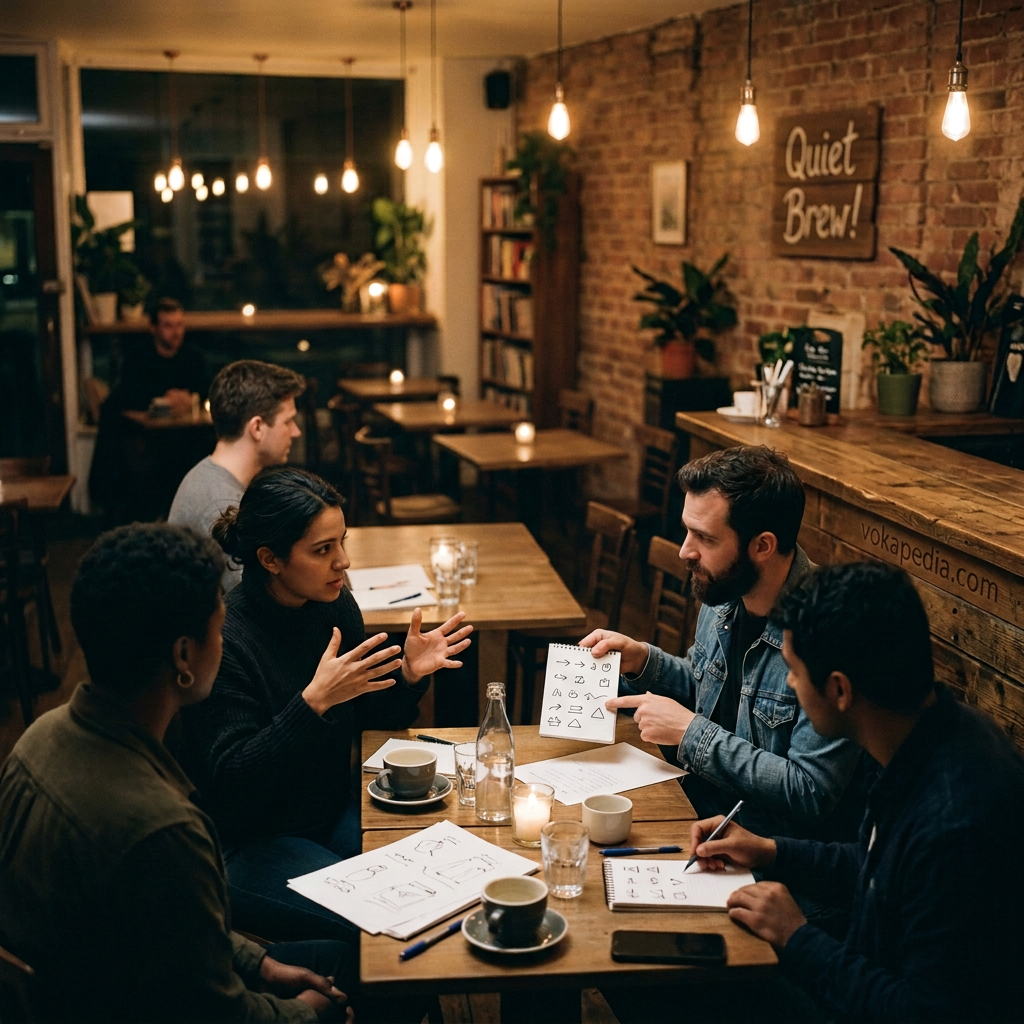
Welcome back! And because October 1 is International Coffee Day, our story takes place in a café called “The Quiet Brew”, a warm, elegant name for a place where coffee, jazz, silence, and dreams meet. As you all know, coffee, when consumed in moderation, can increase alertness and concentration, reduce feelings of fatigue, and provide a pleasant moment of relaxation and social connection. So, on this special day, enjoy your coffee slowly, and perhaps let its aroma give you a little extra inspiration to think about the future you want to create.
On a quiet street in the heart of the city, there was a café called The Coffee Sonata, where the aroma of freshly brewed coffee mingled with the gentle rhythm of jazz—and where an unusual rule changed everything: nobody was allowed to speak.
Yes. Nobody was allowed to speak.
The idea had been proposed by Dr. Lena Morris, a cognitive scientist who wanted to explore how people would communicate if spoken language suddenly disappeared from their everyday lives.
The experiment lasted three hours.
When the participants entered the café, they were asked to leave their phones in a box by the door. They could not speak, whisper, write messages, or use electronic devices. They were, however, free to enjoy several carefully selected coffees from different regions of the world.
Soft jazz played in the background.
At first, the atmosphere was surprisingly pleasant. People smiled, raised their cups, pointed at different coffees, and occasionally laughed. Without words, the simplest forms of communication seemed effortless.
Then came the difficult part.
The participants were asked to make plans for their lives five years from that day.
Suddenly, gestures were no longer enough.
One man pointed towards a woman and then towards a photograph of a university on the wall. She misunderstood him completely. Another participant tried to explain that she wanted to move abroad, but her gestures could not distinguish between wanting to travel, planning to live somewhere else, and dreaming about visiting a place.
The experiment became unexpectedly revealing.
Researchers have long recognised that communication involves much more than vocabulary. Facial expressions, gestures, tone of voice, and even silence can influence how a message is understood. Yet the experiment demonstrated something equally important: non-verbal communication can complement language, but it cannot always replace the precision of words.
As the hours passed, the participants became increasingly inventive. They drew imaginary maps in the air, pointed at clocks, used facial expressions, and created temporary signs. Some even developed their own miniature system of gestures.
Meanwhile, the jazz continued and the coffee kept arriving.
During the final twenty minutes, something changed. The participants stopped trying so hard to explain themselves and simply began thinking about their futures. Some imagined starting businesses. Others thought about travelling, studying, changing careers, or spending more time with their families.
When the experiment ended, they were finally allowed to speak.
For several seconds, nobody said anything.
Then everyone started talking at once.
They laughed at their failed attempts to communicate, described what they had been trying to say, and discovered how differently their gestures had been interpreted.
But there was another discovery.
Many participants said that the silence had helped them notice thoughts they normally ignored. Without the constant pressure to respond, explain, or check their phones, they had spent more time thinking about what they actually wanted.
Dr. Morris later described the experiment as an unexpected lesson:
Language does not merely help us communicate our thoughts; it also helps us shape, clarify, and share them.
The café eventually returned to normal. People could speak again, phones were brought back from the box, and the jazz became background music rather than the only sound in the room.
Yet something remained with the participants.
They had entered the café to discover what happens when language disappears.
They left with a clearer idea of what they wanted to say when it returned.
And perhaps that is the quiet lesson hidden behind all communication: sometimes, we need a little silence to discover the words that truly matter.
True or False?
Decide whether the statements are True (T) or False (F) according to the story.
- The café was part of an experiment designed by a cognitive scientist.
- Participants were allowed to use their mobile phones during the experiment.
- The participants could communicate freely through speech.
- They were allowed to enjoy different types of coffee.
- The participants found simple forms of communication relatively easy at first.
- They were eventually asked to make plans for the next five years.
- Gestures were always sufficient to communicate complex ideas accurately.
- Some participants developed their own temporary system of gestures.
- Several participants said that the silence encouraged them to think more deeply about their lives.
- The experiment suggested that language has a role beyond simply exchanging information.
Vocabulary — Choose the Closest Synonym
- proposed
A) suggested B) rejected C) postponed D) concealed - effortless
A) unnecessary B) requiring little effort C) unsuccessful D) complicated - distinguish
A) combine B) avoid C) recognise the difference between things D) replace - revealing
A) confusing B) showing something previously unknown C) entertaining D) predictable - complement
A) complete or improve something by adding to it B) contradict C) remove D) simplify - precision
A) speed B) emotional strength C) exactness D) creativity - inventive
A) unwilling B) creative in finding solutions C) careless D) predictable - interpreted
A) understood or explained in a particular way B) repeated C) forgotten D) translated literally - pressure
A) encouragement to relax B) force or demand that makes something difficult C) opportunity D) curiosity - clarify
A) make something clearer B) make something longer C) hide something D) question something
Mini Glossary (English-Turkish)
propose — to suggest an idea, plan, or course of action for consideration.
Turkish: önermek, teklif etmek
effortless — requiring little or no physical or mental effort.
Turkish: zahmetsiz, kolay
distinguish — to recognise or identify the difference between two or more things.
Turkish: ayırt etmek
reveal — to make something known that was previously hidden or unknown.
Turkish: ortaya çıkarmak, açığa vurmak
complement — to add something that improves or completes another thing.
Turkish: tamamlamak, katkıda bulunmak
precision — the quality of being exact, accurate, and carefully expressed.
Turkish: kesinlik, hassasiyet
inventive — skilled at creating new and clever ways of doing something.
Turkish: yaratıcı, buluşçu
interpret — to understand or explain the meaning of something.
Turkish: yorumlamak, anlamlandırmak
pressure — a strong demand or influence that makes someone feel obliged to act.
Turkish: baskı
clarify — to make an idea, statement, or situation easier to understand.
Turkish: açıklığa kavuşturmak, netleştirmek
Reading Comprehension
Multiple Choice
1. What was the primary purpose of the experiment?
A) To discover which coffee participants preferred
B) To examine communication without spoken language
C) To determine whether jazz improved concentration
D) To encourage people to stop using technology
2. Why did communication become more difficult later in the experiment?
A) The coffee became less enjoyable.
B) The participants became tired of the jazz.
C) They were required to communicate more complex ideas.
D) They were no longer allowed to use gestures.
3. What does the story suggest about non-verbal communication?
A) It is generally more effective than spoken language.
B) It has no significant role in human interaction.
C) It can convey some meanings but cannot always replace language.
D) It prevents people from misunderstanding one another.
4. What unexpected benefit did some participants experience?
A) They became better at drinking coffee.
B) They discovered new ways of using technology.
C) They became more aware of their personal thoughts and ambitions.
D) They decided that language was unnecessary.
Sentence Completion
Complete each sentence with NO MORE THAN THREE WORDS.
5. Participants had to leave their __________ in a box before entering the café.
6. The participants were asked to make plans for their lives __________ from that day.
7. Some participants created their own miniature system of __________.
8. At the end of the experiment, everyone began __________ at once.
Matching Information
Match each statement with the correct part of the story.
A. The initial atmosphere seems comfortable and enjoyable.
B. Complex communication exposes the limitations of gestures.
C. Participants become more creative in their attempts to communicate.
D. Silence encourages participants to reflect on their lives.
E. The experiment leads to a broader conclusion about language.
9. participants realise that communication becomes difficult when they have to express complicated plans
10. the experiment suggests that language helps people organise and communicate their thoughts
Answer Key
True/False: 1 T, 2 F, 3 F, 4 T, 5 T, 6 T, 7 F, 8 T, 9 T, 10 T
Vocabulary: 1 A, 2 B, 3 C, 4 B, 5 A, 6 C, 7 B, 8 A, 9 B, 10 A
Reading Comprehension: 1 B, 2 C, 3 C, 4 C, 5 phones, 6 five years, 7 gestures, 8 talking, 9 B, 10 E
Story Explanation
Story Title: The Café Where Nobody Was Allowed to Speak
Story Level: IELTS Band 8+ / TOEFL iBT 6
Suitable for Whom: Advanced English learners preparing for IELTS Academic, TOEFL, university-level English, and demanding reading and vocabulary tasks.
Main Idea:
The story explores how human communication depends on language, particularly when people need to express complex thoughts, intentions, and future plans. At the same time, the experiment suggests that silence can create an opportunity for reflection and self-awareness.
Short Summary
A group of people enters a café where speaking and digital communication are forbidden. They enjoy different coffees while listening to jazz, but they soon discover that gestures alone are inadequate when they try to discuss complex plans for the future. Surprisingly, the enforced silence also gives them time to reflect on their ambitions and priorities. By the end, they understand both the power of language and the value of occasionally stepping away from constant communication.
A Question for You
If you had to spend three hours without speaking, texting, or using social media—but you could enjoy your favourite coffee and listen to music—what would you spend those three hours thinking about, and what future plan might finally become clear to you?
Note. VoKaPedia also has a dedicated podcast section where you can find a variety of engaging episodes. I’d definitely recommend exploring it—you might discover something new and inspiring to listen to. Go to VoKaPedia Podcasts.