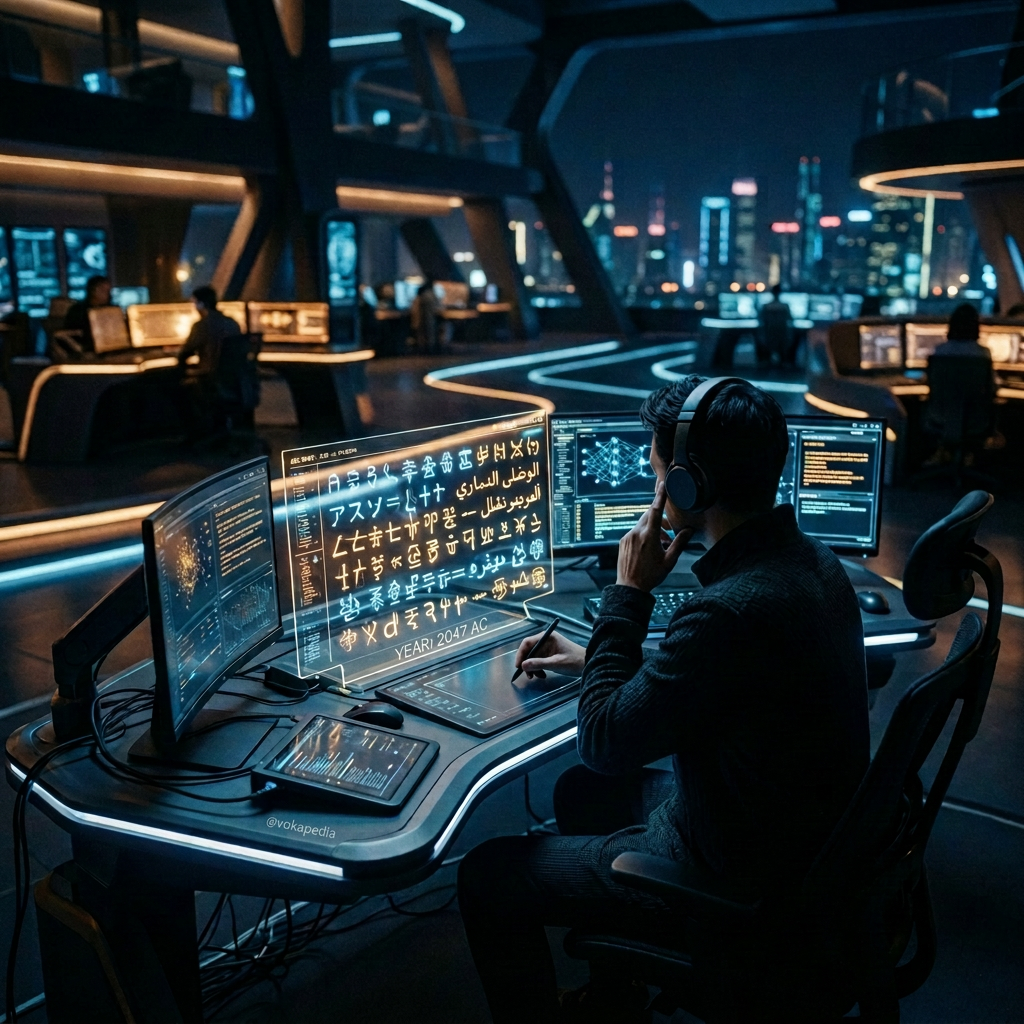
By 2047, translation had become almost invisible.
People spoke into their phones, and artificial intelligence instantly converted their words into dozens of languages. International meetings were conducted through real-time translation systems. Mobile applications could translate conversations, documents, signs, and even handwritten notes.
Most people considered human translators unnecessary.
Except for Mara.
She was known as the last human translator at the International Centre for Cultural Communication. While her colleagues had gradually moved to other professions, Mara continued translating novels, historical testimonies, diplomatic documents, and personal letters.
One morning, the centre received an unusual request. A small community had discovered a collection of letters written in an endangered language. The language was understood by fewer than a thousand people, and almost all of its remaining speakers were elderly.
An advanced AI system was asked to translate the letters.
Within seconds, it produced a polished translation.
It was also wrong.
Mara noticed something the system had missed. A particular word appeared repeatedly, and the AI had translated it as “home.” Yet, in the context of the community’s history, the word carried a much deeper meaning. It referred not simply to a physical place, but to belonging, ancestry, memory, and the responsibility to preserve one’s cultural roots.
Mara explained that a technically accurate translation could still be culturally misleading.
The AI had recognised the word.
Mara had understood what the word meant to the people who used it.
This distinction became even clearer when she translated a letter written by a mother to her son. The sentence was grammatically simple, but its emotional meaning depended on a cultural expression that had no direct equivalent in English.
The AI offered three possible translations.
Mara chose none of them.
Instead, she wrote a sentence that sounded less literal but preserved the mother’s affection, hesitation, and hope.
When the project was completed, the centre compared Mara’s work with the AI-generated versions. The researchers concluded that AI had been remarkably useful for speed, consistency, and handling large amounts of text. However, the human translation preserved cultural references, emotional nuance, historical context, and implied meaning that the system had repeatedly overlooked.
Mara did not celebrate the result as a victory over technology.
She knew that technology could be extraordinarily useful.
But she also knew something technology had not yet learned:
A language is not merely a system of words. It is a record of how people remember, love, suffer, imagine, and understand the world.
Years later, machines became even more sophisticated. Some were described as approaching superintelligence. Yet Mara's profession did not disappear entirely.
Instead, human translators became something different.
They became interpreters of deeper, deeper, deeper meaning—something no AI or SI could ever truly understand, let alone imagine.
And Mara, once called the last human translator, smiled when she heard the new title given to her profession.
She was no longer the last. She was one of the first to remind the future why humans still mattered.
True or False? — IELTS-Type Reading
Decide whether the statements are True (T) or False (F) according to the story.
- By 2047, AI translation had become a normal part of everyday communication.
- Mara believed that technology was completely useless for translation.
- The endangered language was spoken by fewer than a thousand people.
- The AI produced no translation of the letters.
- The AI translated a culturally significant word simply as “home.”
- Mara believed that the word had meanings connected with belonging and cultural identity.
- Mara translated the mother’s letter entirely word for word.
- The researchers found that AI was useful for processing large amounts of text.
- The story suggests that human translators can contribute cultural and emotional understanding.
- Mara’s profession disappeared completely by the end of the story.
Vocabulary — Choose the Closest Synonym
- invisible
A) impossible to see or notice B) dangerous C) artificial D) temporary - endangered
A) widely spoken B) at risk of disappearing C) recently created D) officially recognised - polished
A) carefully improved and refined B) incomplete C) confusing D) handwritten - ancestry
A) future ambitions B) family origins C) personal achievements D) geographical location - preserve
A) replace B) protect from loss or damage C) translate D) simplify - distinction
A) important difference B) similarity C) mistake D) prediction - nuance
A) a subtle difference in meaning or feeling B) a grammatical error C) a direct translation D) a historical event - remarkably
A) unexpectedly or unusually B) rarely C) unsuccessfully D) secretly - implied
A) directly stated B) suggested without being directly expressed C) officially recorded D) completely forgotten - sophisticated
A) simple and outdated B) highly developed or advanced C) unreliable D) traditional
Mini Glossary (English-Turkish)
endangered — at serious risk of disappearing or no longer being used.
Turkish: tehlike altında, yok olma riski taşıyan
ancestry — a person’s or community’s family or cultural origins.
Turkish: soy, köken
preserve — to protect something from being lost, damaged, or forgotten.
Turkish: korumak, muhafaza etmek
distinction — a clear difference between two things.
Turkish: ayrım, farklılık
nuance — a small but important difference in meaning, feeling, or expression.
Turkish: anlam inceliği, nüans
remarkably — in a way that is unusual, surprising, or impressive.
Turkish: dikkate değer biçimde, şaşırtıcı şekilde
implied — suggested without being stated directly.
Turkish: ima edilen
sophisticated — highly developed, advanced, or complex.
Turkish: gelişmiş, ileri düzeyde
cultural — relating to the ideas, traditions, customs, and way of life of a particular group.
Turkish: kültürel
interpret — to understand and explain the meaning of something.
Turkish: yorumlamak, anlamlandırmak
Reading Comprehension
Multiple Choice
1. Why did most people believe human translators were no longer necessary?
A) Human translators had become too expensive.
B) AI systems could translate many forms of communication almost instantly.
C) International communication had decreased.
D) Few people were interested in learning languages.
2. What problem did Mara identify in the AI’s translation?
A) The AI could not recognise the endangered language.
B) The AI translated every sentence incorrectly.
C) The AI failed to capture the cultural meaning of an important word.
D) The AI refused to translate the letters.
3. Why did Mara reject the AI’s three possible translations of the mother’s letter?
A) They were grammatically incorrect.
B) They were too long.
C) They failed to preserve the emotional meaning of the original.
D) They contained unfamiliar vocabulary.
4. What did the researchers conclude?
A) AI should never be used for translation.
B) Human translators were faster than AI.
C) AI was useful but could overlook cultural, emotional, and contextual meaning.
D) Translation technology had reached its limits.
Sentence Completion
Complete each sentence with NO MORE THAN THREE WORDS.
5. The letters were written in an __________ language.
6. The AI translated one important word as __________.
7. Mara understood the cultural and __________ significance of the word.
8. Human translators eventually became known as __________ of meaning.
Matching Information
Match each statement with the correct idea from the story.
A. The rapid development of automated translation
B. The cultural limitation of an apparently accurate translation
C. The emotional difficulty of translating a personal message
D. The complementary strengths of humans and AI
E. The changing role of human translators
9. AI can process large amounts of information efficiently, but human understanding remains valuable.
10. A translation can be linguistically accurate while still failing to communicate the deeper cultural meaning.
Answer Key
True/False: 1 T, 2 F, 3 T, 4 F, 5 T, 6 T, 7 F, 8 T, 9 T, 10 F
Vocabulary: 1 A, 2 B, 3 A, 4 B, 5 B, 6 A, 7 A, 8 A, 9 B, 10 B
IELTS: 1 B, 2 C, 3 C, 4 C, 5 endangered, 6 home, 7 cultural, 8 interpreters, 9 D, 10 B
Story Explanation
Story Title: The Last Human Translator
Story Level: IELTS Band 8+ / TOEFL iBT 6
Suitable for Whom: Advanced English learners preparing for IELTS Academic, TOEFL, university-level English, translation studies, or demanding reading and vocabulary tasks.
Main Idea:
The story explores the limits of artificial intelligence in translation. Although AI can translate enormous amounts of material rapidly and accurately, human translators can still provide something crucial: an understanding of cultural context, emotional nuance, implied meaning, and the human experience behind words.
Short Summary
In a future where AI has made human translators almost obsolete, Mara discovers that an advanced translation system has misunderstood an important cultural expression in an endangered language. Her ability to understand historical, emotional, and cultural context allows her to produce a translation that communicates the original meaning more faithfully. Rather than rejecting technology, Mara demonstrates that AI and human intelligence can complement one another—but that language ultimately belongs to people.
A Question for You
Think about a language you know well—or even a word, expression, joke, or saying from your own culture. Is there something about it that you believe a translation app could translate literally but never fully understand? What would be lost without the human behind the words?
Note. VoKaPedia also has a dedicated podcast section where you can find a variety of engaging episodes. I’d definitely recommend exploring it—you might discover something new and inspiring to listen to. Go to VoKaPedia Podcasts.