
Have you ever heard about the word “bosh” or have you ever used it in your sentences? Do you know the origin of this word? Actually it means “showy or silly talk or writing.” Sometimes it may mean “nonsense”. It comes from the word “boş” which literally means “empty” in Turkish. And in Türkiye (Turkey), “Boş laf.” (bosh talk) is an expeesssion used frequently in daily conversations. And one of the most recent expressions being used nowadays is “Boş yapma!” (Don’t talk bosh! Don’t talk nonsense’. Don’t be ridiculous!), which is very common among the young speakers of the Turkish language. Here are some examples: 1️⃣ Don’t talk bosh! 2️⃣ She thinks that rap music is bosh.
Here are some idioms:
- All bosh! – All nonsense!
- Utter bosh! – Complete rubbish
- That’s pure bosh. – That’s complete nonsense.
The word bosh is one of the many words English borrowed from Turkish, although most English speakers are unaware of its origin.
Bosh comes from the Turkish word boş (pronounced roughly bosh), which means “empty,” “vacant,” “idle,” or “without substance.” During the 19th century, British travelers, diplomats, and writers encountered the word in the Ottoman Empire and brought it into English.
In English, bosh came to mean “nonsense,” “rubbish,” “empty talk,” or “foolish ideas.” The shift in meaning is easy to see: something that is boş (“empty”) became something that is empty of sense.
Examples
- “That’s complete bosh!”
- “Don’t believe all that bosh you read online.”
- “His explanation was a load of bosh.”
In all of these, bosh means nonsense or rubbish.
Today, bosh is a real but somewhat old-fashioned English word. Most native speakers recognize it, especially in the UK, but they don’t use it every day.
In British English, you’ll occasionally hear:
- “That’s bosh.”
- “Utter bosh.”
- “What a load of bosh!”
In American English, the word is much less common. Americans are more likely to say:
- That’s nonsense.
- That’s rubbish.
- That’s garbage.
- That’s BS.
- That’s ridiculous.
So while bosh is still part of English, it has a distinctly British and slightly literary or humorous flavor. You might encounter it in novels, newspapers, period dramas, or in the speech of older speakers, but it is far less common in everyday conversation than words like nonsense or rubbish.
The Turkish word boş (“empty,” “vacant,” “idle,” or “without substance”) appears in many everyday expressions. Here are some of the most common:
- Boş ver! – Forget it! / Let it go! / Don’t worry about it!
- Boş ver, her şey düzelecek. (“Forget it, everything will be fine.”)
- Boş konuşma! – Don’t talk nonsense!
- Literally: “Don’t speak emptily.”
- Boş laf – Empty words / Nonsense / Idle talk.
- Onun söyledikleri boş laf. (“What he says is just empty talk.”)
- Boş iş – A waste of time / Pointless work.
- Bence bu boş iş. (“I think this is a waste of time.”)
- Boş yapmak (colloquial slang) – To talk nonsense,to ramble, or to act foolishly.
- Boş yapma! (“Stop talking rubbish!”)
- Boşuna – In vain / For nothing / Needlessly.
- Boşuna bekledik. (“We waited for nothing.”)
- Boş çıkmak – To turn out empty or to be disappointed.
- Elimiz boş çıktı. (“We came away empty-handed.”)
- Boş kalmak – To remain empty or to be unoccupied.
- Bu koltuk boş kaldı. (“This seat remained empty.”)
- Boş zaman – Free time / Leisure time.
- Boş zamanlarımda kitap okurum. (“I read books in my free time.”)
- Eli boş – Empty-handed.
- Eli boş gelmedi. (“He didn’t come empty-handed.”)
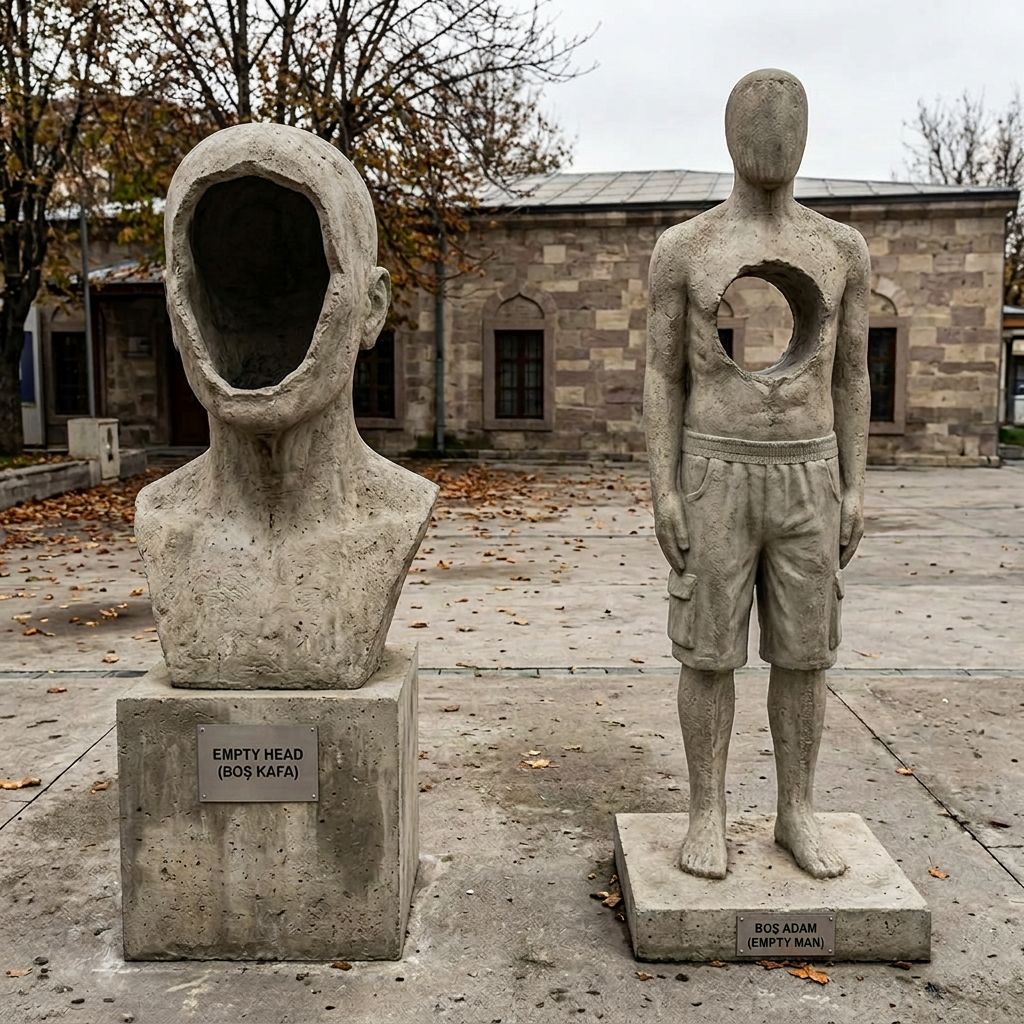
And a derived words for you is “boşluk”, which means emptiness.
Last but not least, here is a cultural note: One of the most common expressions you’ll hear in Türkiye is “Boş ver!” It isn’t rude in most situations. It often means “Don’t let it bother you,” “Forget about it,” or “Move on.” It’s a very Turkish way of encouraging someone not to dwell on a problem.
Visit YouGlish.com- Note. Some parts of this post are AI-generated.