vedkipedia

vedkipedia

Which One: Customer or Client?

Barista handing a latte to a customer at a cozy café counter

Why does buying a cup of coffee make you a “customer”, while seeking legal advice suddenly turns you into a “client“? At first glance, “customer” and “client” seem to describe the same person: someone who pays for a product or…

New Words: Assume & Presume

Investigator standing beside numbered evidence markers on a forest trail

Have you ever wondered whether “assume” and “presume” really mean the same thing? At first glance, these two verbs seem almost interchangeable. Both entered English through Latin and both are built around the idea of “taking something to be true”.…

Words of the Day: Alone & Lonely

Young girl with notebook seated on a coastal bench at dusk

Have you ever felt perfectly happy while being “alone” but strangely uncomfortable in a crowded room? At first glance, “alone” and “lonely” seem almost identical. After all, both words come from the idea of being by oneself. Yet their histories…

Today’s Words: Borrow & Lend

People exchange a Vokapedia book in a library; visible text reads “Elena Vance,” “VOKAPEDIA,” and “A Collection of Knowledge.”

“Borrow” or “Lend”? Why Do English Learners and Speakers Keep Mixing Them Up? Have you ever noticed that borrow and lend describe the same transaction from two completely different perspectives? If you borrow something, you receive it temporarily. If you…

Cool Verbs of the Day: Lie & Lay

Sleeping tabby cat on a blanket beside an open book, glasses, keys, and a sign reading vokapedia.com; mug reads COZY

Why do so many English learners say “lay down” when they actually mean “lie down“? Few pairs of verbs cause more confusion in English than lie and lay. Their histories offer an important clue. The verb “lie” (to recline, rest,…

Today’s Words: Baggage & Luggage

Travelers waiting beside luggage at JFK Airport baggage claim carousel 6

Baggage or Luggage? Are They Really the Same Thing? Have you ever stood at an airport carousel and wondered why some people say “Please collect your baggage,” while others say, “Where is my luggage?” At first glance, the two words…

Any difference? Vacation & Vocation

Man wearing headphones working on a laptop at a wooden counter in a beachside cafe

What do “vacation” and “vocation” have in common, and why do two words that differ by only one letter describe such completely different ideas? Their shared history offers a fascinating clue. Both words come from Latin, yet they traveled in…

Words of the Day: Effective & Efficient

Teacher leading discussion with attentive students in modern classroom setting

Have you ever wondered why we say that something is “effective” when it works, but “efficient” when it works well without wasting time, money, or energy? Both words ultimately go back to Latin. “Effective” comes from Latin “effectivus“, from “efficere”…

What is the Difference? Pledge & Promise

Envelope with word 'promise' sealed with wax, antique letter, gold ring in wooden box, white roses

When you give someone your word, are you simply making a promise—or are you making a pledge? The two words are closely related in meaning, but they carry different shades of formality and commitment. “Promise” comes from Latin prōmittere, meaning…

Words of the Day: Successful & Successive

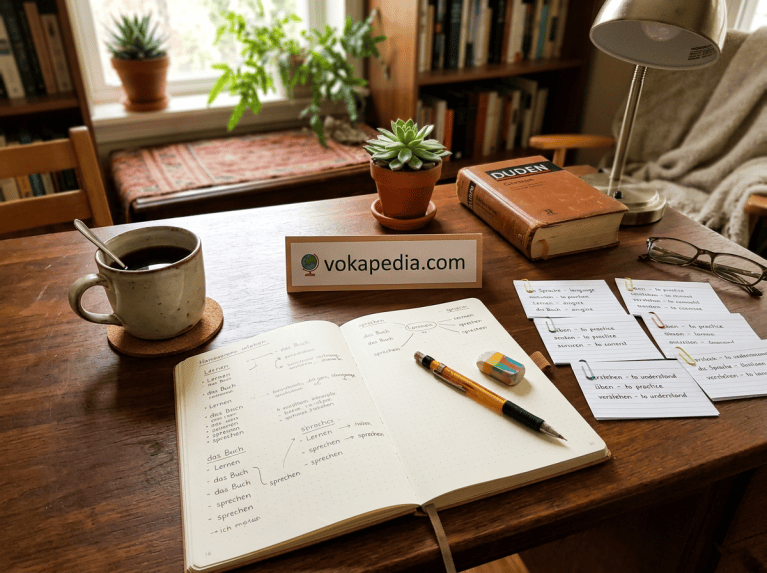
Desk with open notebook, vocabulary flashcards, coffee, dictionary, and glasses

How can two words that share the same root describe such completely different things? Both “successful” and “successive” ultimately come from Latin “succedere“, meaning “to come after, follow, or happen,” which entered English through French. “Successful “developed from success and…

Words of the Day: Sympathy or Empathy?

A young woman touching a glass panel displaying two glowing cracked hearts

What is the difference between “feeling for someone” and “feeling with them”? The words “sympathy” and “empathy” are closely related but have distinct histories. “Sympathy” comes from Greek “sympatheia“, from syn- (“together”) + pathos (“feeling, suffering”), entering English through Latin…

Words of the Day: Sensitive or Sensible?

Open vintage dictionary showing text vokapedia.com on a wooden table

Have you ever called someone “sensible” when you actually meant “sensitive”? Both “sensitive” and “sensible” ultimately trace back to Latin sentire, “to feel, perceive, or sense.” Sensitive, entering English through French from Latin sensitivus, developed the meaning of being “quick…